
Spinal Decompression in Queen Creek, AZ: MRI Terms and Options
Maybe it started with an MRI report. Words like "bulge," "herniation," or "degeneration" are suddenly part of your vocabulary, and somewhere in your reading a decompression table came up. It is natural to want plain-English answers before you call anyone.
We offer non-surgical spinal decompression as one of our chiropractic services. What follows is written for people in Queen Creek and across the East Valley who want to understand common MRI wording, how a decompression table works, how it compares with other options people ask about, and what to ask us.
Understanding the language on an MRI report
Imaging reports are written by and for clinicians, so the wording can be confusing. Here is how some common terms are generally used:
- Disc bulge: generally describes a disc that extends a little past its usual edge, often across a broad area.
- Disc herniation or protrusion: generally describes inner disc material pushing out through, or against, the tougher outer layer in a more focused spot.
- Degeneration or degenerative changes: generally refers to changes in a disc or joint over time, such as reduced disc height.
- Stenosis: generally means narrowing of a space, such as the canal or openings where nerves travel.
These are general definitions for reading comprehension, not an interpretation of your images. Every report is written about one specific person. If you have a report, bring it, or the images, to your visit and we will go over it with you alongside your history and exam.
How a decompression table works
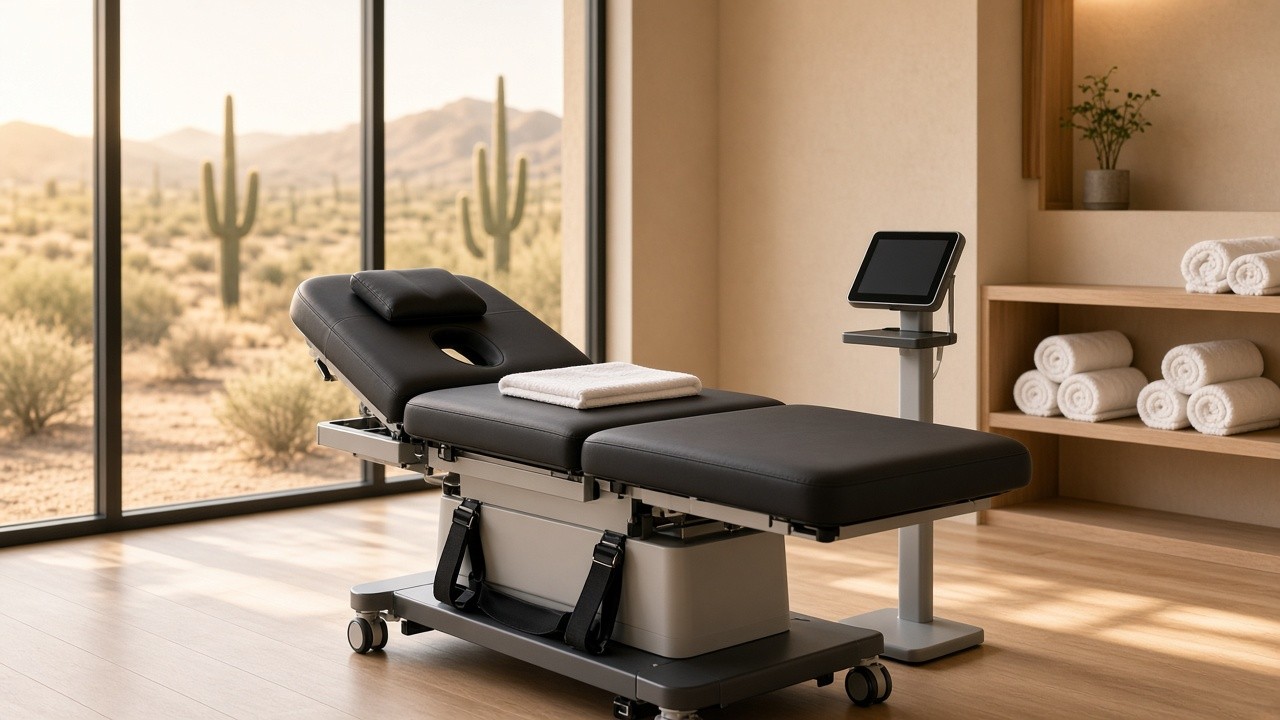
In a chiropractic clinic, spinal decompression usually means lying on a motorized table while a clinician sets up slow, controlled cycles of gentle stretch and release for the low back or neck. The general idea is controlled traction: a steady, adjustable pull that lengthens the spine slightly and then lets it rest, over and over during the session.
During a session, many people describe being comfortably positioned with a harness or support, then feeling cycles of gentle stretch that ease off and repeat. A clinician stays with the setup throughout, and the settings can be adjusted or the session paused whenever you want to talk something over.
Clinic table, home inversion, and surgery: options people ask about
When people research decompression, three other topics usually come up. Here is how they differ:
- Clinic decompression table: motorized, supervised, and set up for you after an exam at our clinic.
- Home inversion table: a consumer device for hanging at an angle or upside down. It is a different thing from clinic decompression, even though both involve stretching the spine.
- Surgery and injections: procedures performed by medical specialists such as spine surgeons and pain management physicians. Those are separate services from anything we offer.
People often see more than one kind of provider over time. If you are already working with another office, let us know what has been done so far; it helps us see where decompression questions fit in.
Long sits on US-60, Power Road, and Ellsworth
Home base is Queen Creek, AZ 85142, and we see patients from San Tan Valley, Gilbert, Mesa, Florence, and surrounding communities. For many people who ask about decompression, the hardest part of the day is a long sit.
That might be a commute up Ellsworth to the Loop 202, west on US-60 toward Mesa and Tempe, or north on Power Road toward Gilbert. It might be a San Tan Valley drive down Hunt Highway, hours in a work truck between job sites, or a long shift at a desk followed by kids' practices. Roads do not cause disc problems, but they shape what people tell us: "It is fine when I walk and worst after the drive home."
That detail is worth mentioning when you call. It helps us understand your day and plan visits around your schedule. All decompression visits take place at our Queen Creek clinic; ask for the easiest route from your side of town when you book.
How decompression fits with adjustments and rehab at our clinic
A visit starts with a conversation: what is bothering you, what you have tried, and how things change with sitting, standing, lifting, and sleep. Then comes the exam. Depending on what we find, decompression may be paired with a Diversified or Activator adjustment, activity guidance, or rehab exercise, or the plan may center on other tools. Either way, we explain the reasoning.
How you hinge, walk, sit, and return to work often matters as much as anything that happens on the table. That rebuilding work lives on our pain relief and rehab page, and you can read more about rehab for our southern neighbors in physical therapy for San Tan Valley. Massage is sometimes part of a plan as well; see massage therapy. If a collision is part of your story, our auto accident therapy page explains how those visits are organized.
Questions to ask us about decompression
- What does the first evaluation include?
- How do you decide whether decompression is part of my plan?
- If it is, how is the number of visits decided, and when do we reassess?
- What does insurance cover, and what would be out of pocket?
- What else might be part of my plan besides the table?
Visit counts are individualized, so it helps to ask how follow-up is decided rather than expecting a set number up front. For the full list of what we offer, see Our Services.
Call or text to talk it through
Call 480-677-2800 or text 602-831-2199. Let us know whether the trouble is in your low back or neck, whether you have an MRI report or other imaging, and which community you are driving from. Hours are Monday–Thursday 8:00 a.m.–6:00 p.m. and Friday 8:00 a.m.–3:00 p.m.
For a broader look at the clinic, start on our homepage or browse the articles library.
FAQ
I have an MRI that mentions a disc bulge. Should I bring it?
Yes, please do. Bring the images or the written report, along with notes from any other providers. We go over them with you alongside your history and exam.
Is the clinic table the same as an inversion table at home?
No. Both involve stretching the spine, but clinic decompression is motorized, supervised, and set up after an exam. A home inversion table is a different device. If you use one, feel free to mention it at your visit.
How many decompression sessions are typical?
There is no standard number. It depends on your exam and your plan, so ask at your evaluation how follow-up visits are decided and when your plan will be reassessed.
Can decompression and an adjustment happen at the same visit?
Sometimes. When decompression is used, it may sit beside joint care and movement work. Many plans include adjustments and rehab without the table. See chiropractic services for the full list.
My worst sitting is the commute from Gilbert or San Tan Valley. Can I be evaluated?
Yes. We regularly see people who drive in from Gilbert, San Tan Valley, Mesa, and Florence; visits happen at our clinic in Queen Creek, 85142. Call 480-677-2800 or text 602-831-2199 and mention that long drives are part of your day.