
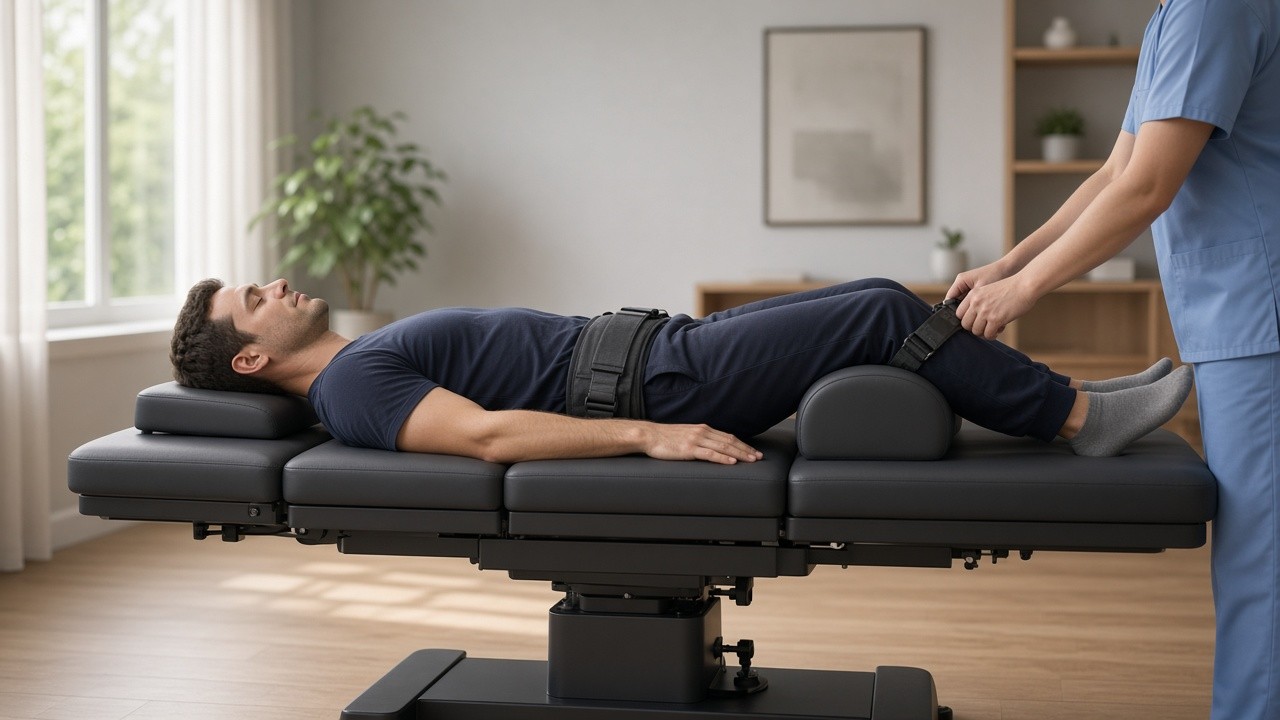
Spinal decompression for Gilbert patients
Spinal decompression and traction therapy are both ways of gently stretching the spine, and both are listed among our services. Gilbert patients who want either one come to our Queen Creek clinic, a short drive southeast. The exam decides which approach fits. For MRI vocabulary and a fuller look at decompression, see our Queen Creek decompression guide.
This page is the shorter companion. It answers the question Gilbert callers ask us most about these two: what is the difference?
Decompression and traction: two kinds of spinal stretch
The two terms get used interchangeably online, which adds to the confusion. Here is how they are described on our chiropractic services page, in plain words:
- Spinal decompression uses a motorized table to gently stretch the spine.
- Traction therapy applies a controlled, sustained stretch to the neck or the lower back.
Both involve a gentle pull that creates a little more length through the spine. The difference is mostly in how the stretch is delivered. In general terms, decompression is usually set up on a motorized table that moves through repeated cycles of stretch and rest. Traction is usually described as a steadier, sustained pull held over a period of time.
Neither one is a "stronger" version of the other. They are two related tools, and the choice between them depends on what we find, where your symptoms are, and how your body responds.
Some Gilbert patients tell us they had traction years ago, at another office or after an old injury, and want to know whether decompression will feel the same. Tell us what you remember: whether it was for the neck or the back, what the setup was like, and how you felt in the days after. That history helps us explain how our approach compares.
Neck or low back: where each one is used
Traction therapy, as listed on our site, can be applied to either the neck or the lower back. For the neck, that means a setup that supports the head and gently lengthens the cervical spine. For the low back, the stretch is directed through the lumbar spine and pelvis.
Spinal decompression comes up most often in conversations about the low back, especially when discs are part of the picture. If your main concern is your neck, ask us which of these options applies to you. That is a question we answer at the exam, based on what we see.
What each one feels like on the table
Most patients are surprised by how calm both feel. You lie on a padded table, usually on your back, and a harness or support is fitted to hold you comfortably in place. A clinician sets things up and stays nearby.
Decompression
People often describe a slow, gentle pull that builds, holds for a moment, and then eases off before repeating. Some say it feels like a long stretch they could not do on their own.
Traction
People often describe a steadier pull that stays fairly constant. For the neck, many mention a feeling of the head being gently drawn away from the shoulders.
With either one, you can tell us at any time if the stretch feels like too much, and the setup can be adjusted. Decompression and traction often sit alongside other care, such as adjustments and corrective exercises from our pain relief and rehab team.
From Cooley Station and Val Vista Lakes to our Queen Creek clinic
Gilbert patients make a short trip to see us, since our one location is a short drive southeast in Queen Creek, AZ 85142.
From Cooley Station, many patients use Williams Field Road or the Loop 202 (Santan Freeway) on the way southeast to Queen Creek. From Val Vista Lakes, the drive is a little longer, and most people take the Loop 202 southeast. Gilbert Regional Park, at Higley and Queen Creek Roads, marks the southeast edge of Gilbert, the part of town closest to us.
If sitting in the car is part of what bothers your back, mention it when you call, and we can talk through times of day that make the drive easier. For more about how Gilbert families use our clinic, see chiropractic for Gilbert sports and active families.
FAQ
Is traction the same as spinal decompression?
They are closely related but not the same. Both gently stretch the spine. Decompression is usually delivered on a motorized table in cycles of stretch and rest, while traction is usually a steadier, sustained pull.
Can decompression or traction be used for the neck?
Traction therapy can be applied to the neck or the lower back. Decompression comes up most often for the low back. If your concern is your neck, we will talk through which options apply after your exam.
How is it decided which one I would get?
The exam decides. We look at where your symptoms are, how you move, and your history, then explain which option we would suggest and why.
Where can I read more about MRI terms?
Our guide to MRI terms and decompression options explains words like "bulge" and "protrusion" in plain language.
Is there a Gilbert office?
No. All visits take place at our clinic in Queen Creek, AZ 85142, a short drive from southeast Gilbert.
Call or text to schedule
To ask whether decompression or traction is part of your plan, call 480-677-2800 or text 602-831-2199. Gilbert patients are welcome. We are in the office Monday–Thursday, 8 a.m.–6 p.m., and Friday, 8 a.m.–3 p.m. Prefer to write? Use our contact page.