
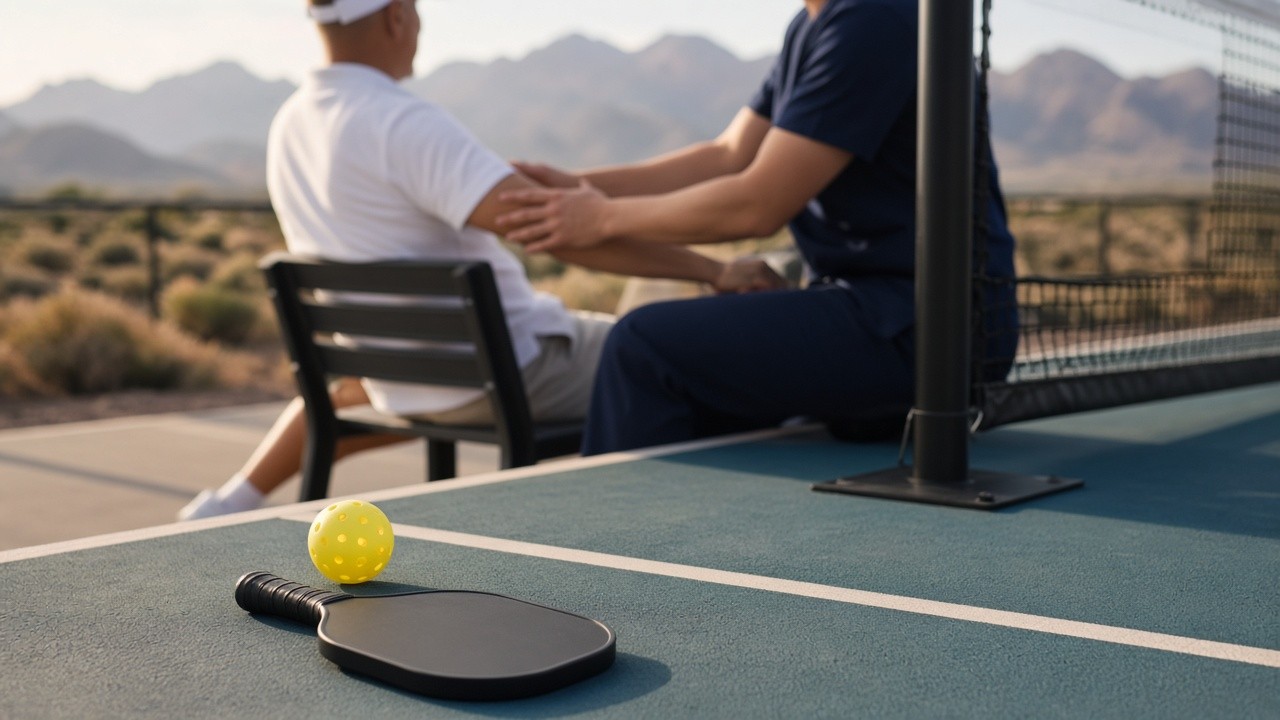
Pickleball injuries we hear about most in the East Valley
The pickleball injuries East Valley players bring to us usually land in five places: the elbow, the shoulder, the knee, the ankle, and the low back. We see players from Queen Creek, Gilbert, Mesa, and San Tan Valley at our Queen Creek clinic, and most of their stories involve the same few motions repeated hundreds of times a week.
Pickleball is easy to pick up and hard to put down. A short court, a light paddle, and a friendly group make it simple to play more often than planned. This page is organized by body part, so you can skip to the area that is talking to you. It describes common movement patterns, not diagnoses, and it will not tell you whether to keep playing. That is a conversation for an exam.
"Pickleball elbow": how it relates to tennis elbow and golfer's elbow
"Pickleball elbow" is a nickname for soreness around the elbow that players link to paddle work. It is not a separate medical condition. Most of the time, people are describing one of two familiar patterns.
- Outer elbow. Tennis elbow describes pain on the outside of the elbow, where the forearm muscles that pull the wrist back attach. Backhands, dinks, and a tight grip on the paddle all load that area.
- Inner elbow. Golfer's elbow describes pain on the inside of the elbow, where the muscles that curl the wrist and fingers attach. Forehands and flicked wrist shots load that side.
Players often notice it first when they pick up a coffee mug, turn a doorknob, or shake hands, not only on the court. "Tennis & Golfer's Elbow" is listed on our pain relief and rehab page, and we look at the wrist, forearm, and shoulder as well as the elbow itself.
Shoulders, overheads, and repeated swings
The rotator cuff is the group of four small muscles that keep the ball of the shoulder centered in its socket while the arm moves. Pickleball asks a lot of it.
Overhead smashes, reaching serves, and quick defensive blocks at the kitchen line all put the shoulder through fast changes of direction. Players who also golf or swim, or who spend workdays reaching overhead, sometimes notice their shoulder sooner. People describe an ache on the outside of the upper arm, a pinch when reaching up, or a shoulder that feels fine during play and complains that night.
When a shoulder is the concern, we look beyond the joint itself. The shoulder blade, the upper back, and the neck all play a part in how the arm swings, so the exam usually includes them. "Rotator Cuff / Shoulder Pain" appears among the injuries we treat on our rehab page.
Knees, ankles, and quick side steps on hard courts
Pickleball is a game of short bursts. Players shuffle sideways, lunge for a low ball, stop hard, and change direction, all on concrete or asphalt courts that do not give much.
Knees
Runner's knee is a common name for an ache around or behind the kneecap. Players often notice it after long sessions of crouching ready at the kitchen line or lunging for dinks. Some also mention tightness along the outside of the thigh, often called the IT band.
Ankles
Ankle sprains happen when the foot rolls, often during a quick lateral step or when backpedaling for a lob. Some players tell us an old sprain still feels "not quite right" months later.
The low back
Bending to scoop balls off the court, rotating through shots, and staying low for long rallies can also leave the low back stiff. It tends to come up alongside knee or hip complaints.
Cooler-season court time: Gilbert Regional Park to Gene Autry Park
From about November through March, the East Valley weather finally cooperates. Daytime outdoor play becomes comfortable again after a summer of early-morning or indoor games, and winter visitors add more players to the courts. That seasonal jump in court time is often when we start hearing about elbows and knees.
Players come from all over our area. In Gilbert, many play at Gilbert Regional Park near Higley and Queen Creek Roads. In Mesa, people mention the Mesa Tennis & Pickleball Center at Gene Autry Park and the courts at Christopher J. Brady Park in south Mesa. Closer to our clinic, Queen Creek players often use the courts at Mansel Carter Oasis Park. Whichever court you call home, a jump from two days a week to five is the kind of change worth mentioning at a visit.
How our extremity and soft-tissue care fits
Many people think of a chiropractor only for backs and necks. Our chiropractic services also include extremity adjusting for joints such as the elbows, wrists, shoulders, knees, and ankles. Depending on what the exam shows, other tools may come into the conversation:
- Extremity adjusting. Adjustments aimed at restricted joints outside the spine.
- Graston Technique. Instrument-assisted soft-tissue work using specialized tools along a muscle or tendon.
- Kinesiology taping. Stretchy tape applied to support muscles and joints without blocking normal movement.
- Shockwave therapy. Focused acoustic pressure waves directed at a tendon or soft-tissue area.
- Corrective exercises and massage. Guided strengthening work and hands-on care from our licensed massage therapists through our massage therapy team.
Not every player needs every tool. We explain what we found, which options we would suggest, and why, and you decide from there. For a look at how we approach active patients more broadly, see our article on physical therapy for heat and sport in San Tan Valley.
FAQ
Is pickleball elbow the same as tennis elbow?
Usually, people mean the same pattern: soreness on the outside of the elbow from gripping and swinging. Some players have it on the inside of the elbow instead, which is usually called golfer's elbow. The exam tells us which area is involved.
Do you work on elbows, shoulders, and knees, or only backs?
We work on both. Extremity adjusting covers joints such as elbows, shoulders, wrists, hips, knees, and ankles, and our rehab services list several sports-related extremity injuries.
I play most mornings in the winter. What should I tell you at my first visit?
Tell us how often you play, how long your sessions run, whether you play singles or doubles, and when the soreness started. If your court time recently went up, mention that too.
Which parts of the body do you look at for a sore shoulder from pickleball?
Along with the shoulder itself, we usually look at the shoulder blade, upper back, and neck, since they all work together when you swing.
Call or text to schedule
If a pickleball ache is sticking around, call 480-677-2800 or text 602-831-2199. We see players from across the East Valley at our Queen Creek clinic. We are open 8 a.m.–6 p.m. Monday to Thursday and 8 a.m.–3 p.m. on Friday.
You can also reach us through our contact page.