
Physical Therapy in Mesa, AZ: Rehab Alongside Chiropractic
A sore shoulder rarely shows up alone. Often there is a stiff upper back behind it, a neck that tightens on the drive home, and a weekend activity you would like to get back to. When people in Mesa search for physical therapy, many are hoping for a plan that looks at all of that together.
That is how rehab works at our clinic in Queen Creek, a reasonable drive for much of Mesa. Rehab, chiropractic care, and massage happen under one roof, and the team talks to each other. This article explains what that looks like and what Mesa patients can expect.
Rehab and chiropractic in the same plan
On our pain relief and rehab page, you will see rehab described as a blend of physical medicine, corrective exercise, and soft-tissue mobilization. Our chiropractic services page covers adjustments for the spine and extremity joints. In many plans, those two pieces work side by side.
A practical example: someone comes in for a knee that aches on stairs. The rehab side looks at strength, balance, and how they squat and step. The chiropractic side may look at how the hip, low back, or ankle is moving. Rather than two separate referrals, it is one conversation with one team. Not every plan needs both, and we explain why each piece is included.
The phases of rehab, explained plainly
Our rehab page describes three general phases. They are a framework rather than a fixed schedule:
- Calming things down: early visits focus on easing the flare and helping you move more comfortably.
- Reintroducing movement: light movement and soft-tissue work, sometimes with tools like the Graston technique or dry needling.
- Building strength: corrective exercise aimed at the activities you care about, from work tasks to sports.
How long each phase takes is individual. We check in as you go and adjust the plan based on how things are moving.
Tools you may see in our rehab area
Depending on the exam, a rehab plan may include:
- Corrective exercises guided during visits and adjusted over time
- Graston technique, an instrument-assisted soft-tissue approach
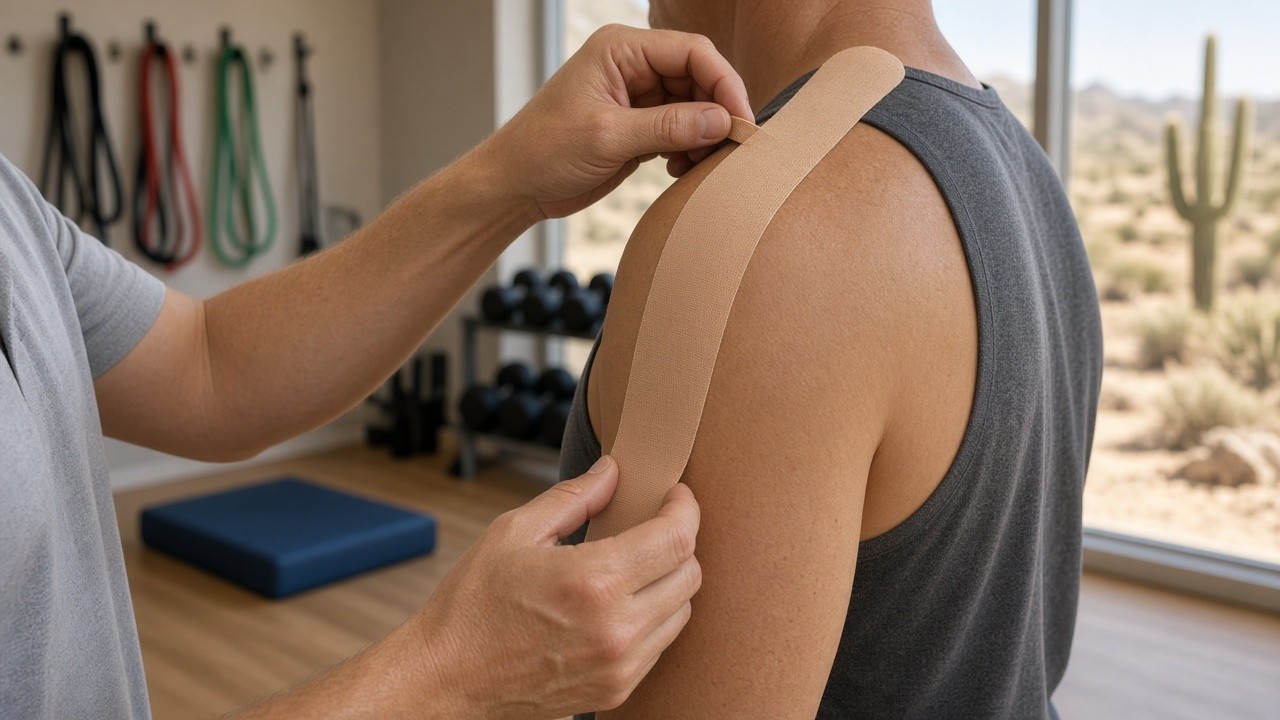
- Kinesiology taping for support during activity
- Joint stabilization work after injuries like sprains
- Post-surgical rehab for people recovering from orthopedic surgery
- Dry needling, which our doctors are certified in; read more on our dry needling page
You will not necessarily see every one of these. Most plans use a handful of tools at a time, chosen around your exam and goals, and the mix changes as you progress. If you are curious about a tool you have read about, ask; we are happy to explain what it is and whether it fits what we found.
Soft-tissue work with our licensed massage therapists or our certified stretch therapist is another option some patients add; see massage therapy.
Trails, courts, and job sites: Mesa activity patterns
Mesa patients bring a wide range of activities with them. Hikers and mountain bikers head to Usery Mountain Regional Park and the trails around the Superstition foothills. Pickleball and tennis players fill courts across the city. Others spend their days on job sites, in warehouses, or in the trades.
Each of those leaves its own pattern. Trail days tend to load knees, ankles, and calves on uneven ground. Court sports tend to involve the shoulder, elbow, and quick changes of direction. Physical jobs tend to involve lifting, overhead work, and long hours on concrete. Telling us what your week looks like helps us understand what your body is being asked to do. Bring the details: how far you hike, how often you play, or how many hours you spend on your feet.
From Superstition Springs and the US-60
We are located in Queen Creek, AZ 85142. Many Mesa patients reach us from the Superstition Springs area by taking Power Road or Sossaman Road south, or by jumping on the US-60 and the Loop 202 and heading southeast. Tell us where you are starting from and we will suggest a direct route.
Hours are Monday–Thursday 8:00 a.m.–6:00 p.m. and Friday 8:00 a.m.–3:00 p.m. If your rehab need started with a car accident, see our auto accident therapy page for how those visits are organized.
How progress check-ins work
Rehab is not a straight line, so we build in regular check-ins. Every so often, we revisit the movements and strength tests from your first visit and compare. Are you reaching higher? Is the stairs test easier? Can you tolerate a longer walk or a heavier lift than before? Your own sense of how daily life feels counts just as much.
Those check-ins shape what happens next. Exercises might progress, change, or be swapped out, and the mix of rehab, chiropractic, and soft-tissue work may shift. We explain the reasoning each time, so you always know why the plan looks the way it does. If something feels off between visits, mention it at your next appointment or give us a call; that feedback is part of the process.
Questions Mesa patients ask about rehab with us
A few questions come up often. People ask how a first visit works: we start with your history and an exam of how you move, then talk through the findings and the possible pieces of a plan. They ask how many visits it will take: that is individualized, and we tell you how follow-up is decided. And they ask about insurance and referrals: rules vary by plan, so ask us what your coverage looks like.
For a look at how we approach rehab for active patients farther south, see physical therapy for San Tan Valley.
Book a rehab visit from Mesa
Call 480-677-2800 or text 602-831-2199. Tell us the area that is bothering you, what you do for work and for fun, and that you are coming from Mesa.
The full list of services is on Our Services. For background on the clinic, see the homepage, and for more reading, the articles library.
FAQ
Can my rehab and chiropractic care be part of the same plan?
Yes, when that fits. Our rehab and chiropractic teams work in the same clinic, and many plans include both. We explain why each piece is included.
What concerns do you commonly work with in rehab?
Shoulders, elbows, knees, heels, and ankles come up often, along with pulled or strained muscles. Our rehab page names several of these, and the evaluation shows how your situation fits.
Do you offer rehab after orthopedic surgery?
Post-surgical rehab is listed among our rehab services. Call 480-677-2800 or text 602-831-2199 to talk about your situation.
I hike at Usery Mountain on weekends. Is that useful to mention?
Yes. Trail time, elevation changes, and uneven ground are all helpful details for understanding what your knees, ankles, and hips are dealing with.
Do I need a doctor's referral?
It depends on your plan. Ask us what your coverage looks like, and our front desk will help you sort it out.
What should I wear to a rehab visit?
Clothes you can move in comfortably, plus athletic shoes. We may ask you to squat, step, lunge, or reach overhead, so loose shorts or leggings and a t-shirt usually work well.