Massage for Mesa patients: matching the type to the problem
Massage in Mesa, AZ starts with one question for us: what is bothering you? AZ Premier Chiropractic & Rehab offers six massage types, and our licensed massage therapists help you pick the one that fits. Our clinic is in Queen Creek, and Mesa patients drive in. We do not have a Mesa office.
Many Mesa callers know they want a massage but not which kind. Deep tissue? Sports? Something called trigger point work? This guide gives each type on our massage menu a short, literal definition, describes what it tends to feel like, and explains how our therapists adjust pressure as they go. It is a chooser, not a sales pitch.
Deep tissue vs. sports massage: what each one targets
These two names get mixed up more than any others. They overlap, but they are not the same thing.
What is deep tissue massage?
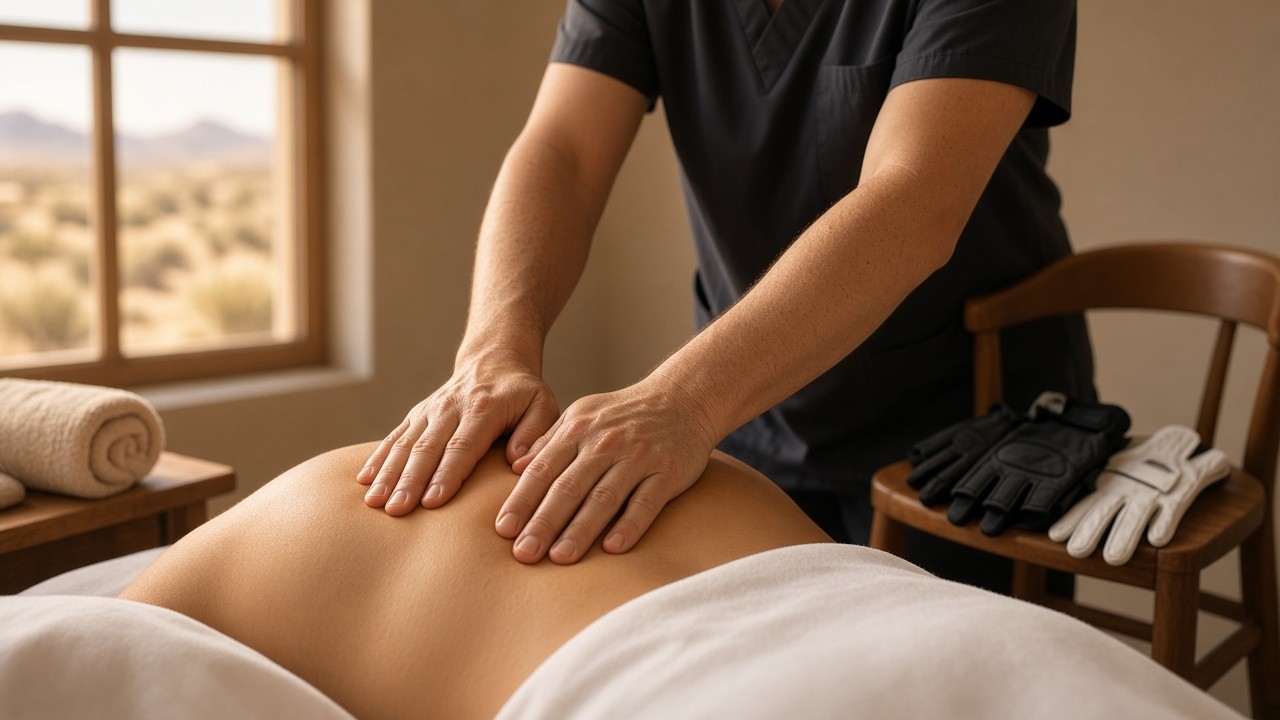
Deep tissue massage works on the deeper layers of muscle and the connective tissue around them. Our therapists use slower strokes and firmer, sustained pressure. People often ask for it when an area such as the neck, upper back, low back, or shoulders has felt tight for a long stretch of time.
What is sports massage?
Sports massage focuses on the parts of the body an activity uses over and over. For a golfer, that may be the trunk, hips, and forearms. For a mountain biker, it may be the quads, hip flexors, and the upper back that holds the riding position. The pace can be brisker than deep tissue, and the therapist builds the session around the motion you repeat most.
A simple way to keep them apart: deep tissue is organized around where it is tight, and sports massage is organized around what you do.
Trigger point work and myofascial release, in plain words
Both of these names sound technical. The ideas behind them are simple.
What is trigger point therapy?
Trigger point therapy uses focused, isolated pressure on a single tight spot, often called a muscle knot, and then a release. The therapist may hold one point for a while before moving on. Some people notice a dull ache that spreads a little away from the spot being pressed.
What is myofascial release?
Myofascial release uses gentle, sustained pressure into the fascia, the thin connective tissue that wraps muscles. Instead of long gliding strokes, the therapist leans in slowly and waits for the tissue to soften. It usually feels slow and steady rather than intense.
Our six massage types at a glance
Here is the full list from our massage therapy page, with what each one focuses on and what it often feels like:
- Deep Tissue Massage focuses on deeper muscle layers and connective tissue. It often feels firm and slow.
- Sports Massage focuses on areas used repeatedly in a sport or activity. It often feels targeted and can be brisk.
- Trigger Point Therapy focuses on individual tight spots. It often feels like steady pressure on one point at a time.
- Myofascial Release focuses on the connective tissue around muscles. It often feels gentle, slow, and sustained.
- Assisted Stretch Therapy focuses on guided stretching with our certified stretch therapist. It feels more like movement than massage.
- Therapeutic Relaxation, often called Swedish massage, uses long, flowing strokes. It often feels light to medium and even.
When relaxation (Swedish-style) massage is the right ask
Not every massage request is about an injury. Sometimes people simply feel run-down, stressed, or wound up after a long stretch of work and travel. Therapeutic relaxation massage is on our menu for that reason. It uses long, flowing strokes at an even pace, with lighter pressure than deep tissue.
If you are not sure whether to ask for relaxation work or something more focused, tell us what the week has felt like. "I just want to unwind" is a perfectly good reason to book.
Golf rounds, trail miles, and winter-visitor season in Mesa
From roughly November through spring, the weather in Mesa turns friendly for outdoor plans. More mornings go to golf, pickleball, and hiking, and winter visitors arrive and fill the tee sheets and trailheads. That seasonal shift is a pattern we notice in what people ask for.
Golfers around the Las Sendas area often mention the mid-back, hips, and forearms after a few rounds in a row. Riders and hikers who spend weekends near Red Mountain Park bring up tight calves, quads, and a stiff upper back. Those stories help our therapists decide where to spend time. They are context for the session, not a diagnosis.
If your soreness started with a fall or a specific injury rather than a busy activity week, let us know when you call. Our clinic also offers chiropractic care and pain relief and rehab, and our licensed massage therapists work alongside our doctors.
Talking about pressure: a simple scale works
Pressure is personal. One person's "firm" is another person's "too much." Our therapists ask before they start and check in as they work, but it helps to have words ready.
Many patients use a plain one-to-ten scale, where one is barely there and ten is more than you want. Others use three words: light, medium, or firm. Either works. You can also point to a spot and say "more here, less there." Our therapists adjust from what you tell them, so speaking up at any point is normal and expected.
It also helps to mention anything recent that may matter, such as a new ache, a sunburn from a weekend round, or an area you would rather the therapist skip.
East and south Mesa vs. north Mesa: an honest look at the drive
Our clinic is in Queen Creek, AZ 85142. For people in east and south Mesa, the trip is usually straightforward. Many take Ellsworth Road south, and others use the Loop 202 (Santan Freeway) and come down from there.
From north and west Mesa, the drive is longer, and we would rather say that up front. Some patients from those areas still choose to come in. When you call, tell us where you are starting from, and we can talk through times that make the drive easier.
If you are curious how massage works for our neighbors to the south, we wrote about massage for Hunt Highway commuters in San Tan Valley.
FAQ
Which massage type should I ask for if I'm sore after mountain biking or a long golf round?
Many people in that spot ask about sports massage, since it is built around the motion you repeat. You do not have to decide alone. Tell us the activity and where you feel it, and your therapist will talk through the options with you.
Is deep tissue massage supposed to hurt?
Deep tissue uses firm pressure, so some people feel intensity in tight areas. It should stay within what you are comfortable with. Tell your therapist if the pressure is more than you want, and they will ease off.
What is the difference between sports massage and deep tissue?
Deep tissue is organized around the deeper layers of a tight area. Sports massage is organized around the parts of the body a specific activity uses most. Many sessions combine elements of both.
Do you offer relaxation massage, or only clinical work?
Therapeutic relaxation, often called Swedish massage, is one of the six types we list. You can ask for it when your goal is to unwind rather than work on a specific problem area.
Do you have an office in Mesa?
No. Our only clinic is in Queen Creek, AZ 85142. Mesa is part of our service area, and many Mesa patients drive in, especially from the east and south sides of the city.
Call or text to schedule
To book massage from Mesa, call 480-677-2800 or text 602-831-2199. Let us know which massage type you are leaning toward, or simply describe what feels tight and we will help you choose. Mesa patients are welcome at our Queen Creek clinic Monday through Thursday from 8:00 a.m. to 6:00 p.m. and on Fridays from 8:00 a.m. to 3:00 p.m.
You can also read about our team or reach us through our contact page.