Dry needling for Mesa patients
Dry needling, cupping, and trigger point massage are three different ways to work on a stubborn muscle knot. Mesa patients who come to our Queen Creek clinic can ask about all three. Our doctors are certified in dry needling, and our licensed massage therapists provide trigger point massage. The exam decides which tool fits, not the name you searched.
A lot of people arrive having read about one of these and heard a friend rave about another. They want to know how the three compare before anyone touches the sore spot. This page lines them up side by side: who does each one, what each one does, and what each one often feels like. It does not crown a winner, because there is not one.
Three tools for tight muscles: a needle, a cup, and a therapist's hands
All three tools aim at the same general problem: a tight, tender area in a muscle that does not let go on its own. They approach it from different directions.
- Dry needling. Who: our doctors, who are certified in dry needling. What: a thin, solid filament needle is placed into a tight spot in the muscle. Often feels like: a quick prick, then sometimes a deep ache or a brief twitch in the muscle.
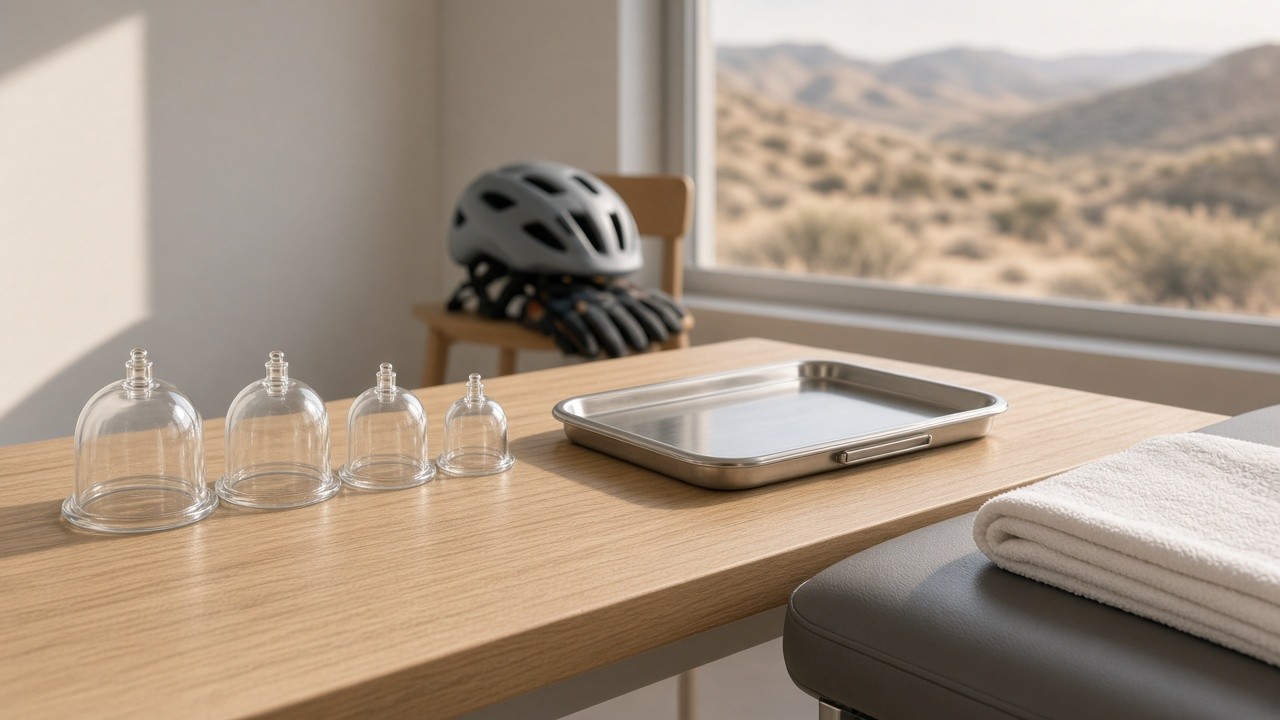
- Cupping. Who: part of our chiropractic services. What: suction cups lift the skin and soft tissue up and away from the muscle underneath, instead of pressing down into it. Often feels like: a tight pulling or drawing sensation.
- Trigger point massage. Who: our licensed massage therapists. What: focused pressure on a single tight spot, held and then released by hand. Often feels like: deep, steady pressure that may ache a little outward from the spot.
Put simply, the needle goes in, the cup pulls up, and the hands press down.
What dry needling targets, briefly
Dry needling aims at trigger points, the small, tight bands inside a muscle that people often call knots. The needle is placed directly into that spot. "Dry" simply means nothing is injected. It is listed among the modalities on our chiropractic services page.
We already wrote a full guide for people trying dry needling for the first time, including how it differs from acupuncture. Rather than repeat it here, see our Queen Creek dry needling guide.
Cupping: lifting tissue instead of pressing into it
Cupping works in the opposite direction from most hands-on care. Instead of pushing into a muscle, a cup placed on the skin creates suction that lifts the skin and the soft tissue beneath it. The idea is to create space in an area that feels stuck or bound down.
Cups may be left in one place or moved slowly along a muscle. People often describe the sensation as tight and pulling rather than sharp. Because cupping lifts rather than presses, some patients who do not enjoy firm pressure find it easier to tolerate. Others prefer the direct feel of hands. Both reactions are normal.
Trigger point massage with our licensed massage therapists
Trigger point therapy is one of the massage types listed on our massage therapy page. A licensed massage therapist finds the tight spot with their fingers, applies isolated pressure, holds it, and then releases. They often work several points in the same area, and they adjust pressure based on what you tell them.
Some people like that a therapist's hands can feel the tissue change in real time. Others like that a massage session can cover a wider area, such as the whole upper back, rather than one spot.
A side note on Graston
You may also hear about the Graston Technique, which uses specialized instruments along a muscle or tendon. It is a separate form of instrument-assisted soft-tissue work listed on our pain relief and rehab page, and it sometimes comes up in the same conversation.
Hawes trail rides and tournament weekends: Mesa knots we hear about
Mesa patients bring us a few familiar stories. Mountain bikers who ride the Hawes Trail System in northeast Mesa often mention a tight upper back and neck from holding the riding position, plus hard-working quads and hips after the climbs.
Weekend tournament days are another pattern. Families who spend Saturdays at the Arizona Athletic Grounds talk about players with tight calves and hamstrings and parents with sore low backs after hours of standing, sitting, and carrying gear.
Then there is the commute. A long drive on the US-60 (Superstition Freeway) tends to show up in the shoulders and between the shoulder blades. Many of our Mesa patients finish that drive by heading south on Signal Butte Road or Ellsworth Road toward our clinic in Queen Creek, AZ 85142. We do not have a Mesa office.
How the tool gets chosen at your visit
We do not start with a tool. We start with you. The visit begins with your history and an exam: where the tight spot is, how you move around it, what makes it worse, and what you have already tried.
From there, we explain what we found and which option or options we would suggest, along with our reasoning. Sometimes that is one tool. Sometimes the plan uses more than one over time. If you have a preference, or a tool you would rather avoid, tell us. That is useful information, and it shapes the conversation.
FAQ
Is dry needling better than cupping?
Neither one is better across the board. They work differently: the needle goes into a tight spot, while the cup lifts tissue away from the muscle. Which one fits depends on what we find at your exam.
Who does the dry needling at your clinic?
Our doctors are certified in dry needling, and they are the ones who perform it.
What does trigger point massage feel like compared with a needle?
Trigger point massage feels like deep, steady pressure from a therapist's fingers on one spot. Dry needling usually feels like a quick prick followed by an ache or a small muscle twitch. People describe both differently.
Do dry needling and trigger point massage work on the same kinds of knots?
Both aim at trigger points, the tight spots in a muscle that people call knots. The difference is the tool: one uses a thin needle, the other uses a therapist's hands.
Call or text to schedule
To ask about dry needling, cupping, or trigger point massage, call 480-677-2800 or text 602-831-2199. Mesa patients are welcome at our Queen Creek clinic from Monday through Thursday, 8 a.m. to 6 p.m., and on Friday, 8 a.m. to 3 p.m. You can also write to us through our contact page.