
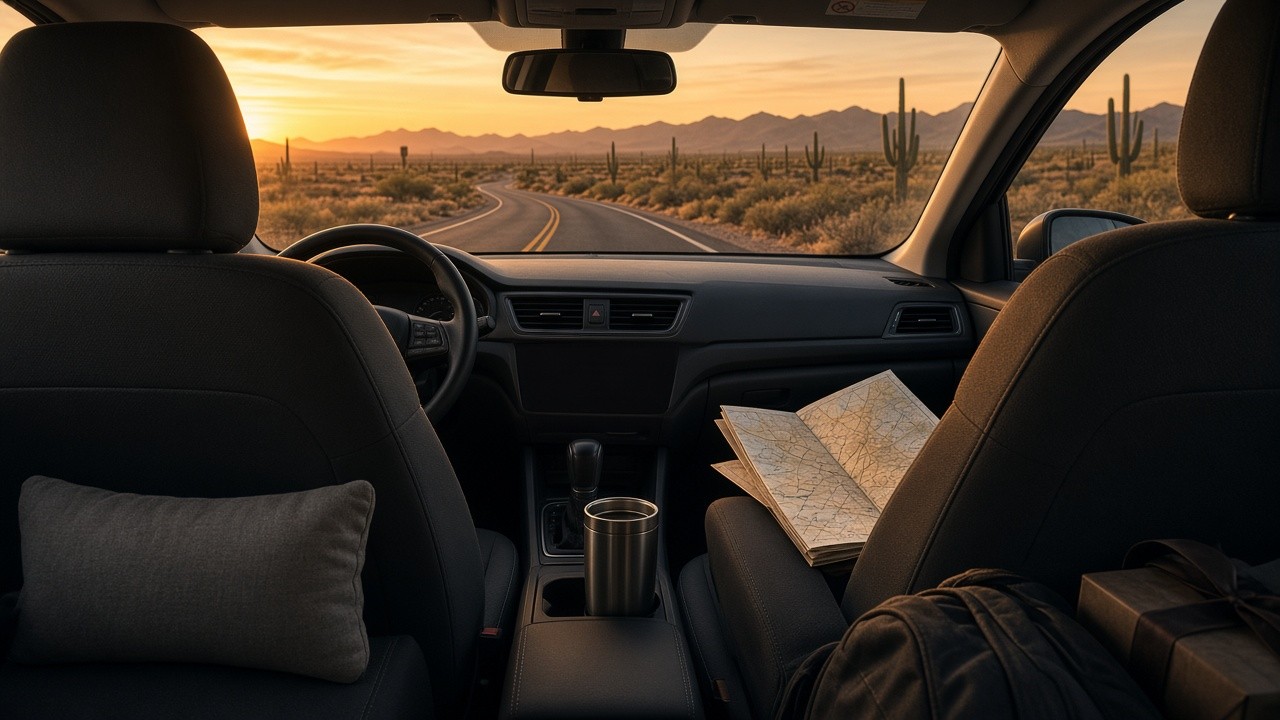
Why long drives bother backs
Back pain from driving usually comes from hours of sitting in one position with the hips bent, the feet working the pedals, and very little chance to move. For East Valley families heading out for Thanksgiving and the holidays, that adds up fast. We see patients with sore low backs and hips after long trips at our Queen Creek clinic.
Holiday travel has a rhythm. Pack the car the night before, leave early to beat traffic, push through to make good time, and unload everything at the other end. Then do it all again a few days later. This page looks at why that pattern can leave the low back and hips complaining, the seat setups many drivers use, what flying adds, and what a visit with us looks like if the soreness follows you home.
What hours in the driver's seat do to the low back and hips
A car seat holds you in a fixed shape. The hips stay bent, the knees stay bent, and the low back often rounds slightly into the seat. Your right leg works the gas and brake while the left one mostly rests. Your hands stay on the wheel, and your eyes stay on the road.
That position is fine for a short trip. Over several hours, people tend to notice a few things:
- A stiff, achy low back when they first stand up at a gas station
- Tight hips and the front of the thighs, from staying bent for so long
- One-sided soreness in the buttock or hip, sometimes on the pedal side
- Upper-back and shoulder tension from holding the wheel
Road vibration, a seat that does not quite fit, and a wallet or phone in a back pocket can add to it. So can the lifting at either end: suitcases, coolers, car seats, and boxes of gifts.
I-17, I-10, and the Beeline: East Valley holiday drives
East Valley holiday trips rarely start short. Many families head north on I-17 toward Flagstaff, or west on I-10 toward Southern California. Others take I-10 south to Tucson, the SR-87 (Beeline Highway) up to Payson, or the US-60 east through Superior.
Thanksgiving week traffic leaving the Valley is a shared experience for a lot of us. Backups at the edges of town can turn a familiar drive into a much longer sit. Our patients from Queen Creek, San Tan Valley, Gilbert, Mesa, and Florence all describe some version of that: the trip took longer than planned, they did not stop as often as they meant to, and their back noticed.
Seat, mirrors, and stops: setups many drivers use
The ideas below are common, general ergonomics that many drivers use. They are not treatment instructions, and what feels right varies from person to person.
- Seat height. Many drivers set the seat high enough to see clearly with the hips about level with, or slightly above, the knees.
- Seat distance. Close enough that the pedals can be pressed fully without stretching, with a slight bend left in the knee.
- Lumbar support. Some cars have a built-in adjustment. Some people use a small pillow or rolled towel behind the low back.
- Mirror position. Setting mirrors while sitting tall can serve as a reminder: if the mirrors seem off later, you may have slumped.
- Rest stops. Many families plan stops every so often to get out, walk around, and stand up straight.
- Back pockets. Moving a wallet or phone out of a back pocket keeps you from sitting unevenly.
Flying out of Gateway or Sky Harbor: carry-ons and airport sitting
Flying swaps one kind of sitting for several. Many East Valley travelers fly out of Phoenix-Mesa Gateway Airport in Mesa or Phoenix Sky Harbor. Either way, the day often includes a drive to the airport, a long security line, a stretch of time at the gate in hard seats, and then a cramped seat on the plane.
Carry-ons add another load. Lifting a heavy bag into an overhead bin means raising weight over your head while twisting in a narrow aisle. Pulling it back down at the end of a flight, after hours of sitting, is a moment many people mention when they describe where their back pain started.
Still sore after the trip: what a visit with us looks like
If the soreness follows you home, a visit starts with the story of the trip: how long you drove or flew, what you lifted, when the pain began, and what makes it better or worse now. Then we look at how your low back and hips move, and where things feel tight or restricted.
Afterward, we explain what we found and the options that may fit. "Lower Back Pain & Sciatica" is listed among the conditions on our chiropractic services page, and depending on the exam, care may include adjustments, corrective exercises from our pain relief and rehab team, or soft-tissue work from our licensed massage therapists through massage therapy. If a busy outdoor season is also part of the picture, our article on physical therapy for heat and sport in San Tan Valley may be useful too.
FAQ
Why does my back hurt more after a long drive than after a day at my desk?
At a desk, most people shift, stand, and walk around without thinking about it. In a car, you stay in one fixed position for hours with your feet working the pedals, and stopping takes planning. Many patients notice the difference.
Does lumbar support in the car make a difference?
Some drivers say it feels more comfortable, and others do not notice much. It is one of several seat settings people adjust, and comfort varies from person to person.
Can I schedule a visit right after I get back from a trip?
Yes. Call or text us when you are back in town, and we will look for a time that works. Let us know how the trip went and what is bothering you.
Is flying or driving harder on the back?
It depends on the trip. A long drive means hours in one seat, while flying adds airport waits, cramped seating, and lifting bags overhead. How long you sit and how much you lift both matter.
Call or text to schedule
If a holiday trip left your back sore, call 480-677-2800 or text 602-831-2199. Our regular hours at the Queen Creek clinic run from 8 in the morning to 6 in the evening Monday through Thursday, and 8 to 3 on Fridays. You can also reach us through our contact page.