
Auto accident chiropractic for Mesa drivers
As an auto accident chiropractor serving Mesa, AZ, we see drivers after rear-end and low-speed crashes, including the ones that leave barely a mark on the car. The first visit at our Queen Creek clinic is a collision exam: a careful history plus orthopedic and neurological checks, so we can explain what we find before any care begins.
A lot of Mesa drivers talk themselves out of calling. The other driver was apologetic, the bumper looks okay, and it seemed too small to make a fuss about. Then the neck feels stiff when they check the mirror, or the low back complains after a day at work. This page is for that situation: a crash that seemed minor, and a body that is not quite sure.
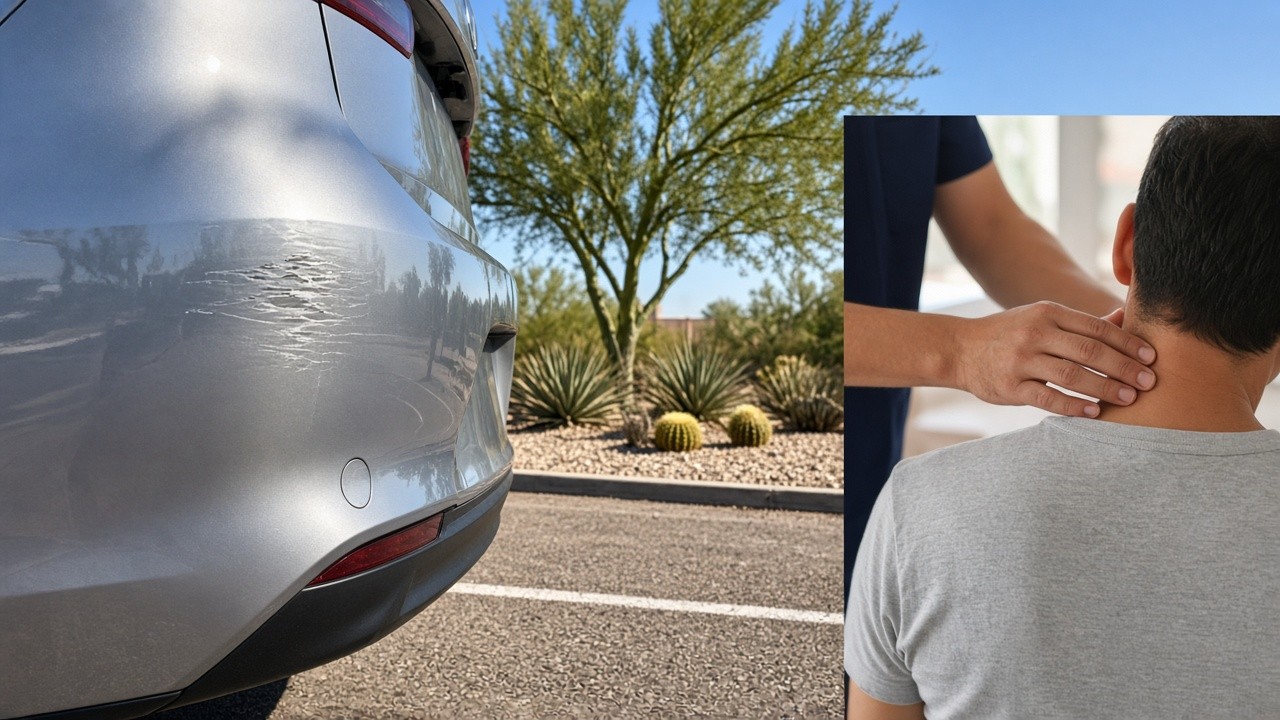
"The car barely has a scratch": low-speed and rear-end crashes
Rear-end collisions are some of the most common crashes we hear about. They often happen at low speed, in stop-and-go traffic, at a red light, or in a parking lot. The car in front is stopped or slowing, and the car behind does not stop in time.
When a car is hit from behind, the seat pushes the body forward, and the head and neck follow a split second later. That quick back-and-forth motion is what people usually mean when they say "whiplash." It can happen whether or not the car shows much damage.
That is why we treat a car's condition and a person's comfort as two separate questions. A body shop can answer the first. A collision exam is how we start on the second. People sometimes feel embarrassed to come in after a "fender-bender." There is no need. Low-speed crashes are part of what our auto accident therapy program is set up for.
Passengers can get overlooked, too. After a crash, most of the conversation tends to center on the driver and the cars. If you were riding along in the front or back seat, a collision exam works the same way for you.
What a collision exam covers compared with a routine visit
A routine chiropractic visit usually focuses on one complaint you already know well, like a familiar stiff neck. A collision exam starts wider, because a crash can involve more than one area at once.
The history
We ask how the crash happened. Were you stopped or moving? Was your head turned? Where were your hands? Were you the driver or a passenger? We also ask what you have noticed since, even things that seem unrelated, such as trouble sleeping or a new ache between the shoulder blades.
Orthopedic and neurological checks
We perform thorough orthopedic and neurological exams. The orthopedic side looks at joints, muscles, and how well you move: neck rotation, shoulder motion, bending through the low back. The neurological side looks at things like reflexes, strength, and sensation in the arms and legs.
Findings and next steps
After the exam, we walk you through what we found in plain language. If care makes sense, we explain the options, which may include adjustments from our chiropractic services, soft-tissue work with our licensed massage therapists through massage therapy, and rehab exercises. Our team keeps detailed records of each visit, which patients can request when they need them.
A simple symptom log between visits
Memory gets fuzzy fast after a crash, especially when work and family keep going. Many patients find it useful to keep a short log on their phone or on paper. It is not a medical tool. It is simply a way to remember what happened so you can tell us accurately. A few lines a day are plenty:
- Date. One entry per day is enough.
- Where it hurts. Neck, upper back, low back, shoulder, head, or somewhere else.
- What makes it worse or easier. Turning to back out of the driveway, sitting at a desk, lifting groceries, lying down.
- Sleep. Whether you slept through the night or woke up stiff.
- Work and driving. Anything you had trouble doing or had to skip.
Bring the log with you, along with the date of the crash and the name of an attorney or adjuster, if one is already involved. If you are curious how we approach whiplash for our San Tan Valley neighbors, we wrote about whiplash care after a crash in San Tan Valley.
US-60, the Loop 202, and Ellsworth Road: where Mesa crashes we hear about happen
Mesa is crossed by some of the busiest roads in the East Valley. The US-60 (Superstition Freeway) runs east and west through the city, and both the Loop 202 Red Mountain Freeway and the Loop 202 Santan Freeway pass through Mesa as well. Commuters on those freeways spend a lot of time in slowing, merging traffic.
On the east side, Ellsworth Road and Signal Butte Road carry steady traffic, and the area around Phoenix-Mesa Gateway Airport adds its own mix of commuters, deliveries, and travelers. Many of the rear-end stories we hear from Mesa patients start on these roads: a backup on the 60, a sudden stop on Ellsworth, a merge near the airport. The setting is just context. What matters for the exam is how the crash happened and how you feel now.
FAQ
Do you see people after minor fender-benders?
Yes. Many of the drivers we see were in low-speed or rear-end crashes where the car had little visible damage. The exam focuses on how you feel and move, not on the car.
What happens at a collision exam?
We start with a detailed history of the crash and what you have noticed since. Then we perform orthopedic and neurological checks, and we explain our findings and any care options before anything begins.
What should I write in a symptom log?
Keep it simple: the date, where it hurts, what makes it better or worse, how you slept, and anything at work or behind the wheel that was harder than usual.
How does insurance work after a crash?
Every situation is different. Ask us what your coverage looks like, and our front desk will walk through your questions with you.
How do Mesa patients usually get to your clinic?
We do not have a Mesa office. Our clinic is in Queen Creek, AZ 85142. Many patients from east and south Mesa drive south on Ellsworth Road or take the Loop 202 Santan Freeway and come down from there.
Call or text to schedule
After a crash, call 480-677-2800 or text 602-831-2199 to set up a collision exam. Mesa drivers are welcome at our Queen Creek clinic. We see patients Monday to Thursday between 8 a.m. and 6 p.m., and Friday between 8 a.m. and 3 p.m.
You can also send us a message through our contact page.